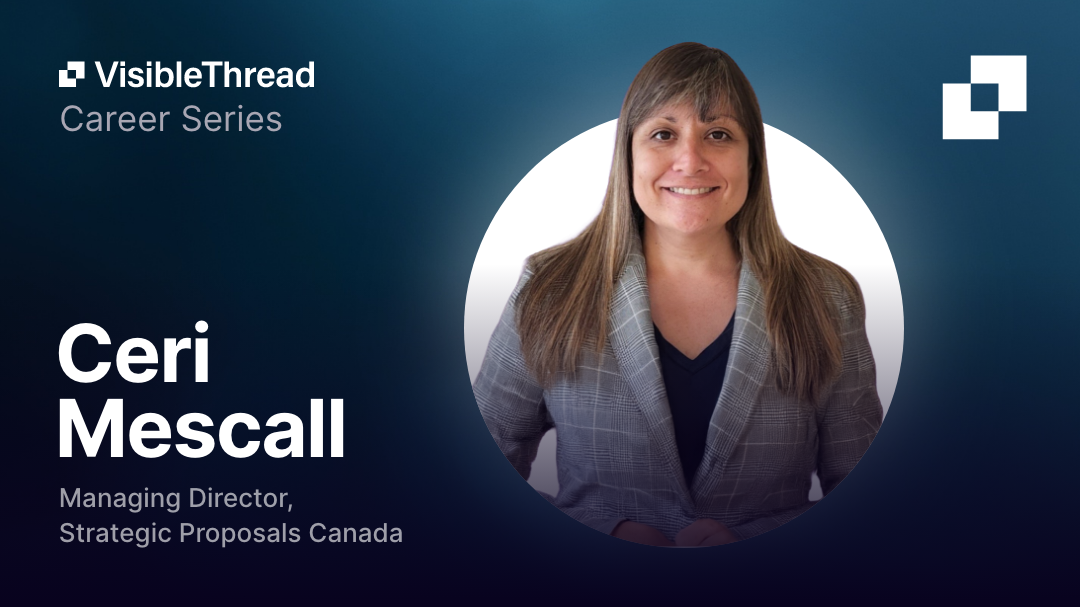
Could you walk me through your career progression and share what sparked your interest in proposals?
I’ve been working in proposals for 19 years now, starting May 2006. Like many people in this field, I fell into it by accident. I graduated with an English degree but had no clear career direction, the generalist nature of the degree opened up almost too many options.
Both my parents were teachers, so I always loved words and learning. In 2006, I saw a job ad for a bid coordinator in the UK and they took a chance on me despite my lack of experience. The role was very tactical and high-volume, involving lots of boilerplate content and production (e.g., printing, binding and last-minute post office runs).
What I loved was the combination of writing, problem-solving and collaboration – translating technical information from subject matter experts into something evaluators could actually understand. There’s a project management side that’s structured, a creative writing side, and a people side that can be complex.
Over time, I moved up from coordinator to proposal management roles that combined writing with strategy and leadership. I became an industry generalist, working across facilities management, workforce solutions and professional services. I moved to Canada in 2018 and joined EY, working as part of a national team with support from offshore proposal coordinators.
I prefer B2B proposals over B2G – government RFPs are very compliance-focused, and I joke that I like coloring outside the lines too much! By 2021, after 15 years in the industry and feeling burned out, I tried solo consulting. In 2023, at the APMP conference, I reconnected with Jon Williams and Graham Ablett from Strategic Proposals (they had trained me for APMP Foundation back in the UK in 2010). We launched Strategic Proposals Canada in April 2024.
I stay involved with the proposals community by delivering training, presentations, webinars, podcasts, and writing articles and posts. I love proposals – I want to help raise the profession’s profile and help others in the field.
We're recognized more as revenue generators than admin, and for connecting sales, SMEs, and leadership.
How has the proposal and bid management landscape changed since you started?
When I started in proposals 19 years ago, there were organizations operating strategically. However, that proposal function maturity and perception of our value is now more widespread. We’re recognized more as revenue generators than admin, and for connecting sales, SMEs, and leadership.
Procurement expectations have also evolved. Compliance is table stakes – what matters is showing understanding, differentiating from the competition, and persuading the reader. There’s growing focus on evaluator psychology as a core skill.
Technology has transformed everything. I remember the days of Microsoft files and folders, trying to merge multiple versions with track changes. Now we have real-time collaboration, automation and AI.
In the last year, we’ve moved from a focus on using AI for content development to freeing us up to focus on what humans do best while handling tasks where AI excels. For example, using AI for go/no go decision-making where humans can struggle due to cognitive biases.
The profession continues to mature, with better tools and stronger integration with adjacent teams and leadership.
Compliance is table stakes - what matters is showing understanding, differentiating from the competition, and persuading the reader.
What’s been one of the most complex problems you’ve had to solve?
The most complex proposal I worked on was a major healthcare technology transformation for a government client. They needed to replace a 20-year-old system used by millions of people.
The process involved multiple proposal rounds and workshops where the solution evolved continuously. Each submission looked different from the previous one. The client used the Vested approach, requiring us to coach team members on mindset and behavior as well as content and delivery.
I was working for one company and we had three teaming partners of varying proposal maturity levels and different organizational cultures. My team led the proposal despite not leading delivery – an exercise in diplomacy!
We conducted extensive research into citizens who were using the current system. We built user personas for our proposals and workshops to demonstrate how they experienced the current system daily and how our solution could improve their lives.
I’ve learned the importance of slowing down initially, taking the time to review all the requirements, aligning the team and making sure we’re moving in the right direction from the start.
What are the most critical skills for succeeding in bid and proposal management today?
Curiosity is the most important. High-performing teams don’t just respond to RFPs – they constantly ask questions about how evaluators will read and decide, what conflicts might arise, and what background factors might influence the deal.
It’s also important to draw insights from other fields. For example, behavioural economics, cognitive psychology and UX design. I use cognitive load theory to simplify technical content, nudge theory and gamification to motivate SMEs, and visual hierarchy principles so evaluators know where to look first.
Influencing without positional authority is crucial since we work across functions often without director titles.
Resilience is essential – burnout is an industry-wide challenge. While external deadlines won’t change, organizations need systematic solutions to support their people rather than putting the onus on employees and individual coping strategies.
Influencing without positional authority is crucial since we work across functions often without director titles.
Is there a skill you now see as essential that you wish you’d focused on earlier?
Around 2019, my manager had a candid conversation with me that I think about often. She said I was excellent at the technical aspects of the role – writing, project management, process – but if I kept doubling down only on those, I’d hit a career ceiling.
This caught me off guard because previous managers had always praised my technical skills. I realized my reputation was built on being reliable and detail-oriented rather than a leader.
Beyond a certain point, success isn’t about what you can deliver alone – it’s about working with teams to deliver together. The interpersonal skills around aligning stakeholders, navigating conflicting priorities, having difficult conversations and building trust across departments is crucial.
Complex proposals succeed or fail based on influence and alignment as well as technical excellence. My advice: build your technical foundation, but don’t stop there. Become a trusted advisor.
My advice: build your technical foundation, but don't stop there. Become a trusted advisor.
How have you developed your professional skill set?
Early on, I focused on technical foundations – joining APMP in 2009, getting certified in 2010, and progressing through all core certifications. These provide structure and frameworks I still use today.
But the most valuable learning has come through peer learning – colleagues, industry peers and reverse mentoring (where I learn as much from people I mentor as they do from me). Networking through webinars, LinkedIn conversations, and virtual coffees has been invaluable.
Becoming an APMP-approved trainer has added a different dimension. Teaching forces you to think like a learner and break down concepts differently. I learn as much delivering courses as participants do.
In recent years, I’ve embraced micro-learning: articles, podcasts, audiobooks for marginal gains from unexpected places. Sometimes these bite-sized pieces are as valuable as formal courses.
The most valuable learning has come through peer learning - colleagues, industry peers and reverse mentoring.
What’s one non-technical skill that’s essential for success in bid management?
Communication versatility. I took a social styles assessment from Tracom that revealed how often I was defaulting to my preferred communication style without adapting to others. I was giving “drivers” (big picture people) too much detail and jumping straight to business rather than making small talk with “expressives” and “amiables” (people who are more relationship than task-focused).
In proposals, you need to flex your communication style not just for different roles but for individuals and their motivations. It’s important to develop range in how you read people and communicate – meet them where they are, but stay authentic.
In proposals, you need to flex your communication style not just for different roles but for individuals and their motivations.
What advice would you give someone starting or transitioning into bid management?
Don’t try to learn everything at once – you’ll overwhelm yourself. Proposal careers build in layers. Focus on foundations first: technical skills. This gives you stability and confidence.
What’s different now is how AI has reshaped the work. The administrative grind that I started with has largely been automated, so expectations are different. You’ll likely have the opportunity to observe and participate in strategy sessions, client conversations, solution development and pricing much earlier in your career than I did.
Success isn’t about busy work or long hours being a badge of honor – it’s about impact. Play the long game on relationships because proposals tends to be a small world where you’ll encounter the same people at different stages of your career.
Success isn't about busy work or long hours being a badge of honor - it's about impact.
Can you recall a challenging bid that didn’t succeed and what you learned?
We had a complex defense sector proposal involving hundreds of pages and 50+ contributors over several months. I was brought in as a consultant during the review stage. Despite massive investment in content, pricing and solution development and numerous reviews, we unfortunately never got to submit the bid.
The end client rejected the proposed consortium structure. The organization had proposed certain teaming partners during earlier stages of the procurement. When they revised these partners, the end client pushed back.
The lesson: always get teaming arrangements approved by the client (as well as approved internally) early – prior to proposal development.
How do you promote work-life balance within your team?
I consider it a leadership accountability issue, not just individual responsibility. Organizations often try solving this with slogans and mindfulness apps, but burnout doesn’t happen because of high stakes and tight deadlines in themselves – it happens when we don’t control internal chaos.
Practical solutions that I’ve seen work are moving Friday reviews to Wednesday (discouraging weekend working to implement edits), strict go/no-go criteria (to avoid overbidding) and protecting your own recovery time (by blocking lunch hours and non-working time in calendars).
As leaders, we must model boundaries. If team members see their managers being steamrollered and working evenings and weekends, they won’t feel comfortable protecting their own time and energy.
As leaders, we must model boundaries. If team members see their managers being steamrollered and working evenings and weekends, they won't feel comfortable protecting their own time and energy.
What changes or innovations will shape the future of proposals?
We’re at an interesting crossroads with AI. The messaging from AI vendors has shifted from “do more proposals faster” to “win more rather than bid more.” AI is freeing us to lean into the areas that have a higher impact on whether we win, such as capture.
AI will accelerate career growth for newer professionals who can jump into strategic work sooner since first-draft creation is becoming automated.
Procurement models are evolving too. Buyers are experimenting with AI for evaluation, changing how proposals are read and scored. I’m seeing more focus on capture and post-proposal workshops and presentations because AI can make written proposals sound similar.
We need serious conversations about proposal career sustainability given the burnout challenges – many teams are stretched thin and in reactive rather than proactive mode. But many organizations are improving in areas such as go/no go governance and workload planning.
The future belongs to people who stay curious and build both technical skills and interpersonal range. Those who insist “this is how we’ve always done it” will get stuck as the industry evolves.