What drew you to the world of bids and proposals?
I think a lot of people say they fell into it, for most of us this is probably true. There was a job opening where I worked after having previously been in the sales team for around five years. Loving the sales environment, I saw a sideways step into bids as an extension to that role. Building the relationship with clients was always one of the more enjoyable aspects of my role in sales, but equally I knew it was time for a new opportunity. Easily the best move I made.
Writing has always come naturally to me. I saw this as the right opportunity at the right time, and I haven’t looked back. I understood the role and knew I could do it well. It is great to see how the industry has evolved over the last 10 years or so, it was relatively unknown when I started. I am an active member of the community on Linkedin and love seeing how it is changing for the better.
Can you tell us about your career journey?
My job history has been varied but equally the also the same. One of my first roles was working for BT Broadband in the early 2000’s at the start of the broadband roll out. There are a lot of contrasts with the work I currently undertake within the Renewable Energy sector, which I can relate to. I definitely view much of this as a full circle moment.
After working for BT, I worked for Chubb Fire Ltd for over 8 years where I was fully established as a sales leader. Working in a number of roles in the sales team, before taking a side step into the world of bids over 10 years ago. This is easily where I learnt the most about sales and relationship building.
I have always worked across big infrastructure, in defence, construction, highways and now renewable infrastructure. Consultancy work has given me opportunities which working for just one employer wouldn’t have afforded me. After my time with Chubb Fire, I set up my first bid consultancy which was in operation for over five years. I only stepped away from this because I was offered an opportunity with Renewables which has taken me down the current path I’m on today.
I have always enjoyed the cut and thrust of sales. The busyness of working in this role, especially with big organisations. My work over the last few years has mostly been working with startups and SME’s, wearing a lot of hats is common, but the growth and development is also much greater than within an established business.
How have you seen the industry change over the years?
The industry has changed massively over my time working within it. I still think the role of a bid professional is massively misunderstood. It is still seen largely by many as an admin role or tick-box exercise. Admittedly these are also the people who don’t win work because they are not doing it properly! The ideal bid person in an organization is a strategist who is orchestrating high-level sales through a successful work-winning approach.
I’m very active on Linkedin and across other channels. My aim is always to spread good information and understanding about the work winning strategy. Whether it is through tips, advice, lessons learnt or just through sharing free resources which can help others to succeed. I educate my clients on best practice everyday and extend that same experience to the wonderful world of social. One recent side project along the same vein is my book entitled “Death By Deadline: finding humor in the small print” – a funny take on proposal problems we all have. The idea behind the book has been a dose of reverse psychology, which hopefully which appeal to everyone working in the business development space.
What has been your biggest professional challenge and how did you overcome it?
Often the biggest bottlenecks in the work winning process can come from how a team works together. A couple of years ago, I was working on a defense contract, our MD was keen to win this work and enter this sector. All the correct frameworks and processes were in place, the failure was getting information from other people in the business, in a timely fashion. I had taken all the action I could leading up to it through escalations, but the deadline was still missed.
It taught me an important lesson: if there is no leadership or management in a scenario, you won’t get the results.
Too many businesses think they can win high-value contracts with zero effort. Life and business just don’t work like that.
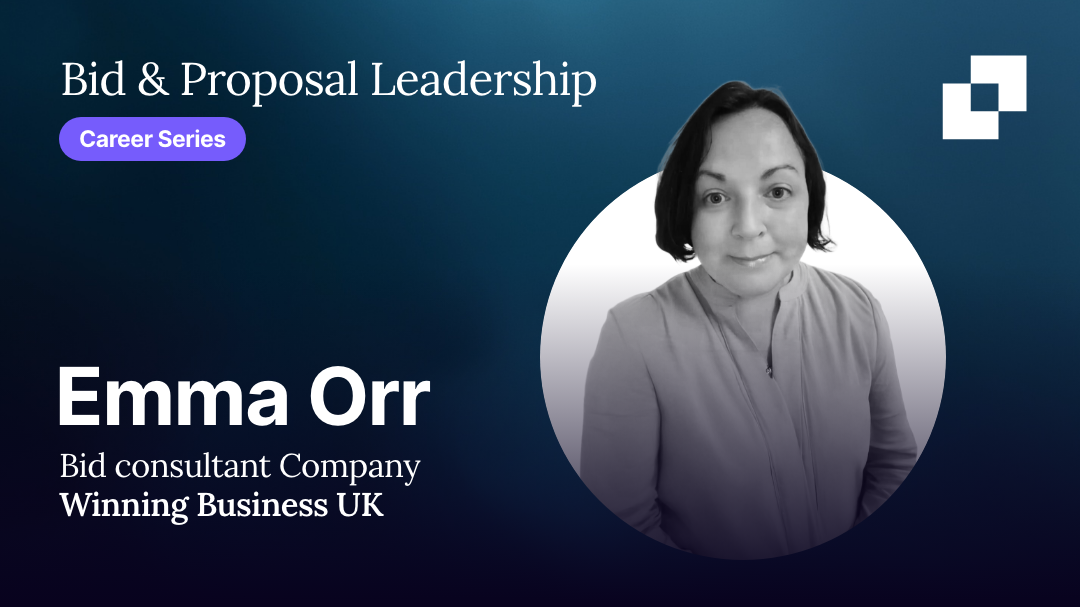
Emma Orr
If you want to win a multi-million-pound contract, you can’t just “answer a few questions”, you must show strategy, commitment, and above all, trust. That’s what the client really wants to know: can they trust you, and will you let them down? They might ask 200 questions, but if you can show them that you’re reliable, that’s what matters.
What are the most critical skills for succeeding in bid and proposal management today?
I always break the role into three parts: sales, research, and writing. It is really a mixture of all three. I see companies hire copywriters and think they can just pull something together, but bids are mostly about strategy with the addition of other core skills. This is where a successful bid is built into fruition.
The real work starts before the bid drops, with research, information gathering, understanding competitors, and building win themes. I call this “bid bites”: pulling insights from press releases, podcasts, videos, anything that helps. Then when the bid arrives, you’ve got a strategy in place.
Good writing skills and attention to detail are also essential. But the research piece is what sets you apart – knowing the customer inside out. Coming from sales helps me a lot, because I’ve heard customers complain face-to-face, and I understand their mentality. That shapes how I write and frame responses.
How have you approached learning new skills?
Mostly by teaching myself on the job. Many companies don’t really know what to do with bid teams, so there’s not much structure. I’ve put myself through APMP qualifications, sales training, and writing courses.
In start-ups, you also have to pick up skills outside your role. For example, when I worked for an EV charging company, I won two contracts worth about £14 million combined. Alongside bids, I had to do stakeholder mapping, keep customers happy, and manage problems internally. With 1,500 charge points to install across London and Birmingham, I ended up doing project management and using geospatial software to coordinate remotely.
Bid teams sit at the centre of everything. HR, marketing, legal, finance, technical, operations. You have to pull from all those areas, so you learn a little about everyone else’s job along the way.
What’s one non-technical skill that’s essential?
Getting on with people. There’s a lot of cajoling and making people feel valued. Most colleagues don’t want to help with bids because they see it as time-consuming and a headache, plus they have their own jobs to do. But the reality is, if you don’t win work, no one gets paid.
I make sure to thank people and acknowledge their contributions once a bid is finished. That relationship piece matters. Also avoiding the same questions to the same people every time, always helps. Having good systems in place while running in an organized business is always the best approach. Operate as a team, show people their input is valued, and they’ll support you repeatedly.
What’s been your most valuable lesson from a proposal you didn’t win?
You lose more bids than you win, that’s just the nature of the job. The lesson is to do the work in between bids. You can’t prepare everything in a two to four week window. You should be updating documents, preparing answers you’d like to be asked, and gathering feedback.
Too many people shut the door on a bid once it has been submitted, do nothing with the feedback, and then make the same mistakes next time. I find there is some irony in those who choose to copy & paste from previously unsuccessful bids. Using core information which also didn’t win.
Continuous improvement is the only way forward.
Emma Orr
What has been the most complex problem you have had to solve to date?
I think every opportunity is different, sometimes the more complex problems come when you don’t have the skills. I don’t think there is much I can’t handle on the proposal front. One of my more recent roles has been working for a startup within EV Charging, my efforts resulted in two contract wins totaling 14 million. In this role, I often had to take on the role of a sales manager/project manager. There had been issues with personnel which were jeopardizing these contracts so I had a few things to do – keep the clients happy, fix the mess, repair the relationship and navigate poor team work.
What advice would you give to someone starting out?
Know that this job is different from most others. If you’re an accountant or a cleaner, you have a set list of tasks. With bids, there are so many variables that change every time. No two bids are the same.
You will always be learning and finding out new things. That’s the challenge, but also the most interesting part. Every sales lead is different, and bids are essentially high-level sales.
My advice is to keep learning, take courses when you can, and see bid skills as transferable. Even if you move into business development or project management, the ability to gather and manage information is invaluable.
What changes or innovations will shape the future of proposals?
AI will undoubtedly shape the future. It can take away a lot of tasks we shouldn’t have to do, like collating information. But my concern is that companies will lean on AI without having the basics: sales thinking, customer focus, and strategy.
Used properly, AI can be powerful. But proposals still need the human element -empathy, persuasion, knowledge. At the end of the day, it’s about convincing the client that you understand them and won’t let them down.